Thursday, 22 November 2018

Spring AOP AspectJ @After Annotation Example | Spring Tutorial

🚀 Level Up Your Java Skills!

If you found this tutorial helpful, don't miss out on more expert coding guides.

SUBSCRIBE TO RAM N JAVA

Mastering the @After Annotation in Spring AOP

Welcome! In this tutorial, we are exploring one of the most useful features of Spring Aspect-Oriented Programming (AOP): the @After advice. This annotation allows you to run specific code automatically after a method finishes its execution.

What is @After Advice?

Think of @After advice like a "finally" block in Java. No matter what happens inside your method—even if it runs successfully or throws an error—the code marked with @After will always run. It's perfect for tasks like closing resources or final logging.

Key Components We Use

  • EmployeeService: This is our main class containing business logic like addEmployee and deleteEmployee.
  • LoggingAspect: This class holds our "Aspect" logic. We use the @Aspect annotation to tell Spring this class contains cross-cutting concerns.
  • The @After Method: Inside our aspect, we create a method (like logAfter) and decorate it with @After to intercept our service calls.

Setting Up the Configuration

To make this work, we need to enable AspectJ support in our Spring configuration file. By adding <aop:aspectj-autoproxy />, Spring knows to look for classes with the @Aspect annotation and apply them to our beans automatically.

Real-World Benefits

Using @After makes your code much cleaner. Instead of adding logging or cleanup code to every single method in your project, you write it once in an Aspect and let Spring handle the rest. It keeps your business logic focused and easy to read!

Explore More Tutorials


Click here to watch on Youtube:
https://www.youtube.com/watch?v=qVDkf0KF19I&list=UUhwKlOVR041tngjerWxVccw

Click the below Image to Enlarge:
Spring AOP AspectJ @After Annotation Example | Spring Tutorial

Spring AOP AspectJ @After Annotation Example | Spring Tutorial

Spring AOP AspectJ @After Annotation Example | Spring Tutorial

pom.xml

<project xmlns="http://maven.apache.org/POM/4.0.0" xmlns:xsi="http://www.w3.org/2001/XMLSchema-instance"
    xsi:schemaLocation="http://maven.apache.org/POM/4.0.0 http://maven.apache.org/maven-v4_0_0.xsd">
    <modelVersion>4.0.0</modelVersion>
    <groupId>com.ram.core</groupId>
    <artifactId>SpringDemo</artifactId>
    <packaging>jar</packaging>
    <version>1.0-SNAPSHOT</version>
    <name>SpringDemo</name>
    <url>http://maven.apache.org</url>

    <properties>
        <spring.version>5.0.5.RELEASE</spring.version>
    </properties>

    <dependencies>
        <dependency>
            <groupId>junit</groupId>
            <artifactId>junit</artifactId>
            <version>3.8.1</version>
            <scope>test</scope>
        </dependency>

        <!-- Spring 5 dependencies -->
        <dependency>
            <groupId>org.springframework</groupId>
            <artifactId>spring-core</artifactId>
            <version>${spring.version}</version>
        </dependency>

        <dependency>
            <groupId>org.springframework</groupId>
            <artifactId>spring-context</artifactId>
            <version>${spring.version}</version>
        </dependency>

        <!-- Spring AOP + AspectJ -->
        <dependency>
            <groupId>org.springframework</groupId>
            <artifactId>spring-aop</artifactId>
            <version>${spring.version}</version>
        </dependency>
       
        <dependency>
            <groupId>org.aspectj</groupId>
            <artifactId>aspectjrt</artifactId>
            <version>1.9.1</version>
        </dependency>
       
        <dependency>
            <groupId>org.aspectj</groupId>
            <artifactId>aspectjweaver</artifactId>
            <version>1.9.1</version>
        </dependency>

    </dependencies>

</project>

EmployeeService.java

package com.ram.service;

public class EmployeeService
{
    public void addEmployee()
    {
        System.out.println("Add Employee ");
    }
   
    public void modifyEmployee()
    {
        System.out.println("Modify Employee");
    }
   
    public void deleteEmployee()
    {
        System.out.println("Delete Employee");
    }

}

LoggingAspect.java

package com.ram.Aspect;

import org.aspectj.lang.JoinPoint;
import org.aspectj.lang.annotation.After;
import org.aspectj.lang.annotation.Aspect;

@Aspect
public class LoggingAspect
{

    @After("execution(* com.ram.service.EmployeeService.addEmployee())")
    public void logAfter(JoinPoint joinPoint)
    {

        System.out.print("logAfter() is running!");
        System.out.println(", after "
                + joinPoint.getSignature().getName() + " method");
        System.out.println("******");
    }

}

applicationContext.xml

<beans xmlns="http://www.springframework.org/schema/beans"
    xmlns:xsi="http://www.w3.org/2001/XMLSchema-instance"
    xmlns:context="http://www.springframework.org/schema/context"
    xmlns:aop="http://www.springframework.org/schema/aop"
    xsi:schemaLocation="http://www.springframework.org/schema/beans
    http://www.springframework.org/schema/beans/spring-beans-4.3.xsd
    http://www.springframework.org/schema/context
    http://www.springframework.org/schema/context/spring-context-4.3.xsd
    http://www.springframework.org/schema/aop
    http://www.springframework.org/schema/aop/spring-aop-4.3.xsd">


    <aop:aspectj-autoproxy />

    <bean id="employeeService" class="com.ram.service.EmployeeService"></bean>
   
    <!-- Aspect -->
    <bean id="logAspect" class="com.ram.Aspect.LoggingAspect" />

</beans>

App.java

package com.ram.core;

import org.springframework.context.ApplicationContext;
import org.springframework.context.support.ClassPathXmlApplicationContext;

import com.ram.service.EmployeeService;

public class App
{
    public static void main(String[] args)
    {
        ApplicationContext context = new ClassPathXmlApplicationContext(
                "applicationContext.xml");

        System.out.println("---------------------------------------");

        EmployeeService employeeService = context
                .getBean("employeeService", EmployeeService.class);

        employeeService.addEmployee();

        employeeService.modifyEmployee();

        employeeService.deleteEmployee();

    }

}

Output

Nov 07, 2018 10:10:23 AM org.springframework.context.support.AbstractApplicationContext prepareRefresh
INFO: Refreshing org.springframework.context.support.ClassPathXmlApplicationContext@32709393: startup date [Wed Nov 07 10:10:23 IST 2018]; root of context hierarchy
Nov 07, 2018 10:10:24 AM org.springframework.beans.factory.xml.XmlBeanDefinitionReader loadBeanDefinitions
INFO: Loading XML bean definitions from class path resource [applicationContext.xml]
---------------------------------------
Add Employee
logAfter() is running!, after addEmployee method
******
Modify Employee
Delete Employee

Click the below link to download the code:
https://sites.google.com/site/ramj2eev2/java_basics/SpringDemo_AspectJ_after.zip?attredirects=0&d=1

Github Link:
https://github.com/ramram43210/javaee/tree/master/Spring_2018/SpringDemo_AspectJ_after

Bitbucket Link:
https://bitbucket.org/ramram43210/spring/src/a5cdfdc3da3c676ee6dec77cfdb6b5c635be29d3/Spring_2018/SpringDemo_AspectJ_after/?at=master

See also:

  • All JavaEE Videos Playlist
  • All JavaEE Videos
  • All JAVA EE Links
  • Spring Tutorial
  • Servlets Tutorial
  • All Design Patterns Links
  • JDBC Tutorial
  • Java Collection Framework Tutorial
  • JAVA Tutorial
  • Kids Tutorial
  • Cooking Tutorial
  • Spring AOP AspectJ Before Advice example using XML configuration | Spring Tutorial

    🚀 Ready to Master Java Development?

    Don't miss out on the latest Spring Framework tutorials! Join thousands of learners today.

    SUBSCRIBE NOW

    Understanding Spring AOP: Before Advice

    In this guide, we break down one of the most powerful features of Spring Aspect-Oriented Programming (AOP): the Before Advice. This allows you to run specific logic right before your main method starts its work.

    What is Before Advice?

    The "Before Advice" is a piece of code that executes before the actual business logic method is called. It is commonly used for security checks, logging, or setting up prerequisites. In this tutorial, we focus on implementing it using XML Configuration.

    Key Project Parts

    • EmployeeService: Our target class containing methods like addEmployee().
    • LoggingAspect: The class where we write the "advice" (the logging code).
    • XML Config: The file where we tell Spring to link the two together.

    How It Works in Simple Steps

    To set this up, we use the <aop:before> tag inside our XML configuration. We define a Pointcut, which is essentially a rule that tells Spring: "Every time someone calls the addEmployee method, run our logging code first." This keeps your business code clean and focused on just adding employees!

    Why Use XML Instead of Annotations?

    While modern projects often use annotations, XML configuration is fantastic for legacy systems or when you want to manage your aspects in one single place without modifying your actual Java classes. It's a great skill for any professional Java developer to have.

    More Great Content from My Channel


    Click here to watch on Youtube:
    https://www.youtube.com/watch?v=7jN64twSuxk&list=UUhwKlOVR041tngjerWxVccw

    Click the below Image to Enlarge:

    Spring AOP AspectJ Before Advice example using XML configuration | Spring Tutorial

    Spring AOP AspectJ Before Advice example using XML configuration | Spring Tutorial

    Spring AOP AspectJ Before Advice example using XML configuration | Spring Tutorial

    pom.xml

    <project xmlns="http://maven.apache.org/POM/4.0.0" xmlns:xsi="http://www.w3.org/2001/XMLSchema-instance"
        xsi:schemaLocation="http://maven.apache.org/POM/4.0.0 http://maven.apache.org/maven-v4_0_0.xsd">
        <modelVersion>4.0.0</modelVersion>
        <groupId>com.ram.core</groupId>
        <artifactId>SpringDemo</artifactId>
        <packaging>jar</packaging>
        <version>1.0-SNAPSHOT</version>
        <name>SpringDemo</name>
        <url>http://maven.apache.org</url>

        <properties>
            <spring.version>5.0.5.RELEASE</spring.version>
        </properties>

        <dependencies>
            <dependency>
                <groupId>junit</groupId>
                <artifactId>junit</artifactId>
                <version>3.8.1</version>
                <scope>test</scope>
            </dependency>

            <!-- Spring 5 dependencies -->
            <dependency>
                <groupId>org.springframework</groupId>
                <artifactId>spring-core</artifactId>
                <version>${spring.version}</version>
            </dependency>

            <dependency>
                <groupId>org.springframework</groupId>
                <artifactId>spring-context</artifactId>
                <version>${spring.version}</version>
            </dependency>

            <!-- Spring AOP + AspectJ -->
            <dependency>
                <groupId>org.springframework</groupId>
                <artifactId>spring-aop</artifactId>
                <version>${spring.version}</version>
            </dependency>
           
            <dependency>
                <groupId>org.aspectj</groupId>
                <artifactId>aspectjrt</artifactId>
                <version>1.9.1</version>
            </dependency>
           
            <dependency>
                <groupId>org.aspectj</groupId>
                <artifactId>aspectjweaver</artifactId>
                <version>1.9.1</version>
            </dependency>

        </dependencies>

    </project>

    EmployeeService.java

    package com.ram.service;

    public class EmployeeService
    {
        public void addEmployee()
        {
            System.out.println("addEmployee() is called");
        }
       
        public void modifyEmployee()
        {
            System.out.println("modifyEmployee() is called");
        }
       
        public void deleteEmployee()
        {
            System.out.println("deleteEmployee() is called");
        }

    }

    LoggingAspect.java

    package com.ram.Aspect;

    import org.aspectj.lang.JoinPoint;

    public class LoggingAspect
    {
        public void logBefore(JoinPoint joinPoint)
        {

            System.out.print("logBefore() is running!");
            System.out.println(", before "
                    + joinPoint.getSignature().getName() + " method");
            System.out.println("******");
        }

    }

    applicationContext.xml

    <beans xmlns="http://www.springframework.org/schema/beans"
        xmlns:xsi="http://www.w3.org/2001/XMLSchema-instance"
        xmlns:context="http://www.springframework.org/schema/context"
        xmlns:aop="http://www.springframework.org/schema/aop"
        xsi:schemaLocation="http://www.springframework.org/schema/beans
        http://www.springframework.org/schema/beans/spring-beans-4.3.xsd
        http://www.springframework.org/schema/context
        http://www.springframework.org/schema/context/spring-context-4.3.xsd
        http://www.springframework.org/schema/aop
        http://www.springframework.org/schema/aop/spring-aop-4.3.xsd">


        <bean id="employeeService" class="com.ram.service.EmployeeService"></bean>

        <!-- Aspect -->
        <bean id="logAspect" class="com.ram.Aspect.LoggingAspect" />

        <aop:config>

            <aop:aspect id="aspectLoggging" ref="logAspect">

                <!-- @Before -->
                <aop:pointcut id="pointCutBefore"
                    expression="execution(* com.ram.service.EmployeeService.addEmployee()))" />

                <aop:before method="logBefore" pointcut-ref="pointCutBefore" />

            </aop:aspect>

        </aop:config>

    </beans>

    App.java

    package com.ram.core;

    import org.springframework.context.ApplicationContext;
    import org.springframework.context.support.ClassPathXmlApplicationContext;

    import com.ram.service.EmployeeService;

    public class App
    {
        public static void main(String[] args)
        {
            ApplicationContext context = new ClassPathXmlApplicationContext(
                    "applicationContext.xml");

            System.out.println("---------------------------------------");

            EmployeeService employeeService = context
                    .getBean("employeeService", EmployeeService.class);

            employeeService.addEmployee();

            employeeService.modifyEmployee();

            employeeService.deleteEmployee();

        }

    }

    Output

    Nov 07, 2018 9:14:40 AM org.springframework.context.support.AbstractApplicationContext prepareRefresh
    INFO: Refreshing org.springframework.context.support.ClassPathXmlApplicationContext@32709393: startup date [Wed Nov 07 09:14:40 IST 2018]; root of context hierarchy
    Nov 07, 2018 9:14:40 AM org.springframework.beans.factory.xml.XmlBeanDefinitionReader loadBeanDefinitions
    INFO: Loading XML bean definitions from class path resource [applicationContext.xml]
    ---------------------------------------
    logBefore() is running!, before addEmployee method
    ******
    addEmployee() is called
    modifyEmployee() is called
    deleteEmployee() is called

    Click the below link to download the code:
    https://sites.google.com/site/ramj2eev2/java_basics/SpringDemo_aspectj_before_xml_config.zip?attredirects=0&d=1

    Github Link:
    https://github.com/ramram43210/javaee/tree/master/Spring_2018/SpringDemo_aspectj_before_xml_config

    Bitbucket Link:
    https://bitbucket.org/ramram43210/spring/src/a5cdfdc3da3c676ee6dec77cfdb6b5c635be29d3/Spring_2018/SpringDemo_aspectj_before_xml_config/?at=master

    See also:

  • All JavaEE Videos Playlist
  • All JavaEE Videos
  • All JAVA EE Links
  • Spring Tutorial
  • Servlets Tutorial
  • All Design Patterns Links
  • JDBC Tutorial
  • Java Collection Framework Tutorial
  • JAVA Tutorial
  • Kids Tutorial
  • Cooking Tutorial
  • Wednesday, 21 November 2018

    java.sql.Timestamp class | Java Date and Time - Playlist

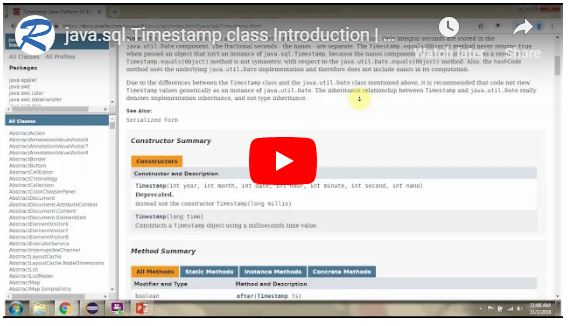
    java.sql.Timestamp class Introduction | Java Date and Time


    Click here to watch on Youtube:
    https://www.youtube.com/watch?v=7w_r2ILMFuI&list=UUhwKlOVR041tngjerWxVccw

    Click the below Image to Enlarge:
    java.sql.Timestamp class Introduction | Java Date and Time

    TimestampDemo.java

    import java.sql.Timestamp;

    public class TimestampDemo
    {
        public static void main(String[] args)
        {
            long millisecond = System.currentTimeMillis();

            /*
             * Constructs a Timestamp object using a milliseconds time
             * value. The integral seconds are stored in the underlying
             * date value; the fractional seconds are stored in the nanos
             * field of the Timestamp object.
             *
             * Parameters:
             *
             * time - milliseconds since January 1, 1970, 00:00:00 GMT. A
             * negative number is the number of milliseconds before
             * January 1, 1970, 00:00:00 GMT.
             */

            Timestamp timestamp = new Timestamp(millisecond);
            System.out.println(timestamp);
        }

    }

    Output

    2018-11-03 11:04:10.96

    Refer: 
    https://docs.oracle.com/javase/8/docs/api/index.html?java/sql/Timestamp.html

    Click the below link to download the code:
    https://sites.google.com/site/ramj2eev2/java_basics/TimestampDemo_Intro.zip?attredirects=0&d=1

    Github Link:
    https://github.com/ramram43210/Java/tree/master/BasicJava_2018/TimestampDemo_Intro

    Bitbucket Link:
    https://bitbucket.org/ramram43210/java/src/4cfac93378c4f9d33f18bb5083115d18778294de/BasicJava_2018/TimestampDemo_Intro/?at=master

    See also:


  • All JavaEE Videos Playlist
  • All JavaEE Videos
  • All JAVA EE Links
  • Spring Tutorial
  • Servlets Tutorial
  • All Design Patterns Links
  • JDBC Tutorial
  • Java Collection Framework Tutorial
  • JAVA Tutorial
  • Kids Tutorial
  • Cooking Tutorial
  • How to use setTime(long time) method of java.sql.Time class | Java Date and Time


    Click here to watch on Youtube: 
    https://www.youtube.com/watch?v=CILW7YwJuPI&list=UUhwKlOVR041tngjerWxVccw

    TimeDemo.java

    import java.sql.Time;

    public class TimeDemo
    {

        public static void main(String[] args)
        {

            Time time = Time.valueOf("15:06:00");
            System.out.println("Before setTime = " + time);

            /*
             * Sets a Time object using a milliseconds time value.
             */

            time.setTime(System.currentTimeMillis());
            System.out.println("After setTime  = " + time);

        }

    }

    Output

    Before setTime = 15:06:00
    After setTime  = 09:51:09

    Click the below link to download the code:
    https://sites.google.com/site/ramj2eev2/java_basics/TimeDemo_setTime.zip?attredirects=0&d=1

    Github Link:
    https://github.com/ramram43210/Java/tree/master/BasicJava_2018/TimeDemo_setTime

    Bitbucket Link:
    https://bitbucket.org/ramram43210/java/src/4cfac93378c4f9d33f18bb5083115d18778294de/BasicJava_2018/TimeDemo_setTime/?at=master

    See also:
  • All JavaEE Videos Playlist
  • All JavaEE Videos
  • All JAVA EE Links
  • Spring Tutorial
  • Servlets Tutorial
  • All Design Patterns Links
  • JDBC Tutorial
  • Java Collection Framework Tutorial
  • JAVA Tutorial
  • Kids Tutorial
  • Cooking Tutorial
  • How to use toLocalTime() method of java.sql.Time class | Java Date and Time


    Click here to watch on Youtube: 
    https://www.youtube.com/watch?v=dROtKL0KKXw&list=UUhwKlOVR041tngjerWxVccw

    TimeDemo.java

    import java.sql.Time;
    import java.time.LocalTime;

    public class TimeDemo
    {

        public static void main(String[] args)
        {

            Time time = Time.valueOf("15:06:20");
            System.out.println("time      = "+time);

            /*
             *
             * The conversion creates a LocalTime that represents the same
             * hour, minute, and second time value as this Time.
             *
             * Returns:
             *
             * a LocalTime object representing the same time value
             */

            LocalTime localTime = time.toLocalTime();
            System.out.println("localTime = "+localTime);

        }

    }

    Output

    time      = 15:06:20
    localTime = 15:06:20

    Click the below link to download the code:
    https://sites.google.com/site/ramj2eev2/java_basics/TimeDemo_toLocalTime.zip?attredirects=0&d=1

    Github Link:
    https://github.com/ramram43210/Java/tree/master/BasicJava_2018/TimeDemo_toLocalTime

    Bitbucket Link:
    https://bitbucket.org/ramram43210/java/src/4cfac93378c4f9d33f18bb5083115d18778294de/BasicJava_2018/TimeDemo_toLocalTime/?at=master

    See also:

  • All JavaEE Videos Playlist
  • All JavaEE Videos
  • All JAVA EE Links
  • Spring Tutorial
  • Servlets Tutorial
  • All Design Patterns Links
  • JDBC Tutorial
  • Java Collection Framework Tutorial
  • JAVA Tutorial
  • Kids Tutorial
  • Cooking Tutorial
  • Tutorials