

Click here to watch in Youtube : https://www.youtube.com/watch?v=nGKTQtc5x1U
Click the below Image to Enlarge
 |
| JDBCRowSet Event Handling |
 |
| JDBCRowSet Event Handling |
 |
| JDBCRowSet Event Handling |

|
| JDBCRowSet Event Handling |
|
| JDBCRowSet Event Handling |
|
| JDBCRowSet Event Handling |
Subscribe to Ram N Java for regular, beginner-friendly programming tutorials and real-world coding demos!
SUBSCRIBE NOWIn standard Java Database Connectivity (JDBC), working with standard ResultSet objects often requires manually opening connections, managing statements, and tracking resource life cycles. A JDBCRowSet wraps a standard ResultSet into a JavaBean component, making database handling flexible, easy to configure, and scrollable by default.
To implement a JdbcRowSet in your Java application, you follow these straightforward steps:
RowSetProvider.newFactory() to obtain an instance of RowSetFactory.rowSetFactory.createJdbcRowSet() to get your row set instance.setCommand() and bind query placeholders with setters like setString().execute() to load the records, iterate through the row set, and access column values smoothly.import java.sql.SQLException;
import java.util.Scanner;
import javax.sql.rowset.JdbcRowSet;
import javax.sql.rowset.RowSetFactory;
import javax.sql.rowset.RowSetProvider;
public class JdbcRowSetDemo {
public static void main(String[] args) {
JdbcRowSetDemo demo = new JdbcRowSetDemo();
try (Scanner scanner = new Scanner(System.in)) {
System.out.print("Enter Country Code (e.g., IND, USA): ");
String countryCode = scanner.next();
demo.getCityInformation(countryCode);
} catch (Exception e) {
e.printStackTrace();
}
}
public void getCityInformation(String countryCode) {
try {
// 1. Create RowSetFactory
RowSetFactory factory = RowSetProvider.newFactory();
// 2. Create JdbcRowSet instance
try (JdbcRowSet jdbcRowSet = factory.createJdbcRowSet()) {
// 3. Set connection properties
jdbcRowSet.setUrl("jdbc:mysql://localhost:3306/world");
jdbcRowSet.setUsername("root");
jdbcRowSet.setPassword("password");
// 4. Set SQL query command and bind parameters
jdbcRowSet.setCommand("SELECT ID, Name, CountryCode, District, Population FROM city WHERE CountryCode = ?");
jdbcRowSet.setString(1, countryCode);
// 5. Execute query
jdbcRowSet.execute();
// 6. Iterate through the records
while (jdbcRowSet.next()) {
System.out.println("ID: " + jdbcRowSet.getInt("ID"));
System.out.println("Name: " + jdbcRowSet.getString("Name"));
System.out.println("CountryCode: " + jdbcRowSet.getString("CountryCode"));
System.out.println("District: " + jdbcRowSet.getString("District"));
System.out.println("Population: " + jdbcRowSet.getInt("Population"));
System.out.println("------------------------------------------");
}
}
} catch (SQLException e) {
e.printStackTrace();
}
}
} |
| JDBCRowSet |
 |
| JDBCRowSet |
 |
| JDBCRowSet |
import java.sql.SQLException;
import java.util.Scanner;

import javax.sql.rowset.JdbcRowSet;
import javax.sql.rowset.RowSetFactory;
import javax.sql.rowset.RowSetProvider;

public class JDBCRowSetDemo
{
    // JDBC driver name and database URL
    static final String JDBC_DRIVER = "com.mysql.jdbc.Driver";
    static final String DB_URL      = "jdbc:mysql://localhost:3306/world";

    // Database credentials
    static final String USERNAME    = "root";
    static final String PASSWORD    = "root";

    public static void main( String[] args )
    {
        JDBCRowSetDemo jdbcRowSetDemo = new JDBCRowSetDemo();
        Scanner scanner = new Scanner(System.in);
        while( true )
        {
            System.out.print("Enter City Country Code :");
            String cityCountrycode = scanner.nextLine();

            if( cityCountrycode.equals("exit") )
            {
                break;
            }

            jdbcRowSetDemo.getCityInformation(cityCountrycode);

        }
        scanner.close();
    }

    private void getCityInformation( String cityCountrycode )
    {
        JdbcRowSet jdbcRowSet = null;
        try
        {
            /*
             * Using RowSetFactory create the JdbcRowSet object.
             */
            RowSetFactory rowSetFactory = RowSetProvider.newFactory();
            jdbcRowSet = rowSetFactory.createJdbcRowSet();

            /*
             * Set the JdbcRowSet properties [URL,username,password,command]
             */
            jdbcRowSet.setUrl(DB_URL);
            jdbcRowSet.setUsername(USERNAME);
            jdbcRowSet.setPassword(PASSWORD);

            /*
             * Sets the command property with a query that produces a ResultSet
             * object containing all the data in the table
             */

            jdbcRowSet.setCommand("select * from city where countrycode=?");
            jdbcRowSet.setString(1, cityCountrycode);

            /*
             * The execute method does many things for you in the background:
             *
             *  1.It makes a connection to the database using the values you assigned to the url,
             *    username, and password properties.
             *
             *  2.It executes the query you set in the command property.
             *
             *  3.It reads the data from the resulting ResultSet object into the jdbcRs object.
             *
             */
            jdbcRowSet.execute();

            /*
             *  Iterate the jdbcRowSet and get each row information
             *  of city table.
             */

            while( jdbcRowSet.next() )
            {
                int id = jdbcRowSet.getInt(1);
                String name = jdbcRowSet.getString(2);
                String countryCode = jdbcRowSet.getString(3);
                String district = jdbcRowSet.getString(4);
                int population = jdbcRowSet.getInt(5);

                /*
                 * Display values
                 */
                System.out.print("ID: " + id);
                System.out.print(", Name: " + name);
                System.out.print(", CountryCode: " + countryCode);
                System.out.print(", District: " + district);
                System.out.println(", Population: " + population);
            }

        }
        catch( SQLException se )
        {
            se.printStackTrace();
        }
        catch( Exception e )
        {
            e.printStackTrace();
        }

        finally
        {
            if(jdbcRowSet!=null)
            {
                try
                {
                    jdbcRowSet.close();
                }
                catch( SQLException e )
                {
                    e.printStackTrace();
                }
            }
        }

    }
}
Enter City Country Code :ind
ID: 1024, Name: Mumbai (Bombay), CountryCode: IND, District: Maharashtra, Population: 10500000
ID: 1025, Name: Delhi, CountryCode: IND, District: Delhi, Population: 7206704
ID: 1026, Name: Calcutta [Kolkata], CountryCode: IND, District: West Bengali, Population: 4399819
ID: 1027, Name: Chennai (Madras), CountryCode: IND, District: Tamil Nadu, Population: 3841396

---
---


Enter City Country Code :pak
ID: 2822, Name: Karachi, CountryCode: PAK, District: Sindh, Population: 9269265
ID: 2823, Name: Lahore, CountryCode: PAK, District: Punjab, Population: 5063499
ID: 2824, Name: Faisalabad, CountryCode: PAK, District: Punjab, Population: 1977246
ID: 2825, Name: Rawalpindi, CountryCode: PAK, District: Punjab, Population: 1406214

---
---

Enter City Country Code :exit

 |
| JDBCRowSet |
 |
| JDBCRowSet |
 |
| JDBCRowSet |

 |
| JDBC Transaction Management Demo |
 |
| JDBC Transaction Management Demo |
import java.sql.Connection;
import java.sql.DriverManager;
import java.sql.SQLException;
import java.sql.Statement;

public class JDBCTransactionManagementDemo
{
    // JDBC driver name and database URL
    static final String JDBC_DRIVER = "com.mysql.jdbc.Driver";
    static final String DB_URL      = "jdbc:mysql://localhost:3306/world";

    // Database credentials
    static final String USERNAME    = "root";
    static final String PASSWORD    = "root";

    public static void main( String[] args )
    {
        JDBCTransactionManagementDemo jdbcTransactionManagementDemo =
                                             new JDBCTransactionManagementDemo();
        jdbcTransactionManagementDemo.addCityInformation();
    }

    private void addCityInformation()
    {
        Connection connection = null;
        Statement statement = null;
        try
        {
            /*
             * Register the JDBC driver in DriverManager
             */

            Class.forName(JDBC_DRIVER);

            /*
             * Establish connection to the Database using DriverManager
             */

            connection = DriverManager
                    .getConnection(DB_URL, USERNAME, PASSWORD);

            /*
             * Set auto-commit to false
             */
            connection.setAutoCommit(false);

            String sql1 = "insert into city values(6000,'Bangalore','IND','Karnataka',400000)";
            String sql2 = "insert into city values(6001,'Channai','IND','TamilNadu',200000)";
            String sql3 = "insert into city values(6002,'Thiruvanathapuram','IND','Kerala',800000)";

            /*
             * Execute the query
             */
            statement = connection.createStatement();

            /*
             * Execute each sql one by one
             */
            statement.executeUpdate(sql1);
            System.out.println(sql1 + " : Sql1 is Successfully executed");
            statement.executeUpdate(sql2);
            System.out.println(sql2 + ": Sql2 is Successfully executed");
            statement.executeUpdate(sql3);
            System.out.println(sql3 + ": Sql3 is Successfully executed");

            /*
             * If there is no error
             */
            connection.commit();

            System.out
                    .println("Changes are committed and applied to the Database");

        }
        catch( SQLException se )
        {
            /*
             * Handle errors for JDBC
             */
            try
            {
                /*
                 * If there is any error.
                 */
                connection.rollback();
                System.out
                        .println("Changes are rollbacked and not applied to the Database");
            }
            catch( SQLException e )
            {
                e.printStackTrace();
            }
            se.printStackTrace();
        }
        catch( ClassNotFoundException e )
        {
            /*
             * Handle errors for Class.forName
             */
            e.printStackTrace();
        }
        catch( Exception e )
        {
            try
            {
                /*
                 * If there is any error.
                 */
                connection.rollback();
                System.out
                        .println("Changes are rollbacked and not applied to the Database");
            }
            catch( SQLException e1 )
            {

                e1.printStackTrace();
            }
            e.printStackTrace();
        }
        finally
        {
            /*
             * finally block used to close resources
             */
            try
            {
                if( statement != null )
                {
                    statement.close();
                }
            }
            catch( SQLException sqlException )
            {
                sqlException.printStackTrace();
            }
            try
            {
                if( connection != null )
                {
                    connection.close();
                }
            }
            catch( SQLException sqlException )
            {
                sqlException.printStackTrace();
            }
        }

    }
}
insert into city values(6000,'Bangalore','IND','Karnataka',400000) : Sql1 is Successfully executed
insert into city values(6001,'Channai','IND','TamilNadu',200000): Sql2 is Successfully executed
insert into city values(6002,'Thiruvanathapuram','IND','Kerala',800000): Sql3 is Successfully executed
Changes are committed and applied to the Database

 |
| JDBC Transaction Management |
 |
| JDBC Transaction Management |
 |
| JDBC Transaction Management |
 |
| JDBC Transaction Management |

 |
| JDBC : Retrieve File |
 |
| JDBC : Retrieve File |
 |
| JDBC : Retrieve File |
 |
| JDBC : Retrieve File |
 |
| JDBC : Retrieve File |
 |
| JDBC : Retrieve File |
import java.io.FileWriter;
import java.io.Reader;
import java.sql.Clob;
import java.sql.Connection;
import java.sql.DriverManager;
import java.sql.PreparedStatement;
import java.sql.ResultSet;
import java.sql.SQLException;

public class JDBCRetriveFileDemo
{
    // JDBC driver name and database URL
    static final String JDBC_DRIVER = "com.mysql.jdbc.Driver";
    static final String DB_URL      = "jdbc:mysql://localhost:3306/world";

    // Database credentials
    static final String USERNAME    = "root";
    static final String PASSWORD    = "root";

    public static void main( String[] args )
    {
        JDBCRetriveFileDemo jdbcRetriveFileDemo = new JDBCRetriveFileDemo();
        jdbcRetriveFileDemo.retriveFile();
    }

    private void retriveFile()
    {
        Connection connection = null;
        PreparedStatement preparedStatement = null;
        try
        {
            /*
             * Register the JDBC driver in DriverManager
             */

            Class.forName(JDBC_DRIVER);

            /*
             * Establish connection to the Database using DriverManager
             */

            connection = DriverManager
                    .getConnection(DB_URL, USERNAME, PASSWORD);

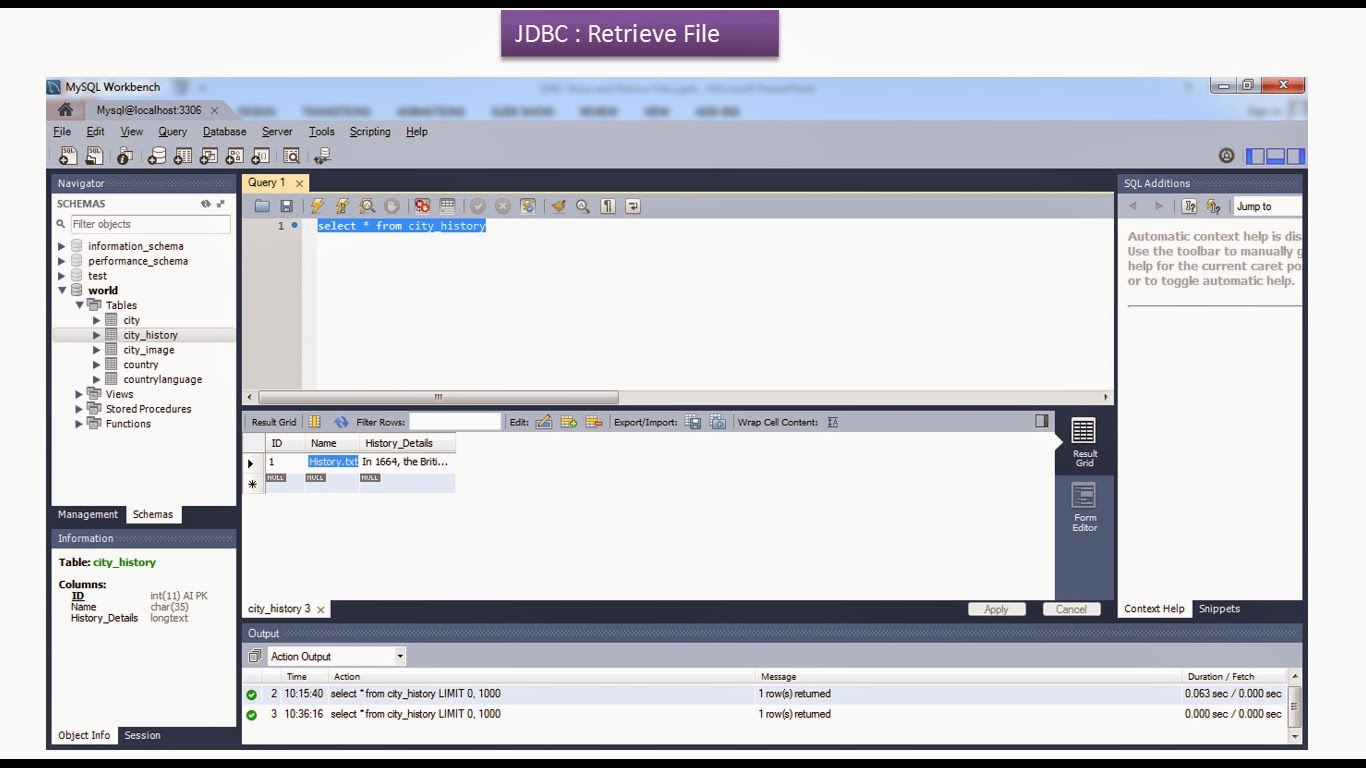
            String sql = "select * from CITY_HISTORY";

            /*
             * Execute the query
             */
            preparedStatement = connection.prepareStatement(sql);
            ResultSet rs = preparedStatement.executeQuery();

            while( rs.next() )
            {
                String name = rs.getString(2);
                Clob cityHistoryClob = rs.getClob(3);
                Reader reader = cityHistoryClob.getCharacterStream();

                FileWriter fw = new FileWriter("D:/Downloads/" + name );

                int i;
                while( (i = reader.read()) != -1 )
                {
                    fw.write((char) i);
                }
                System.out.println("D:/Downloads/" + name +" has saved");
                fw.close();
            }

            rs.close();

        }
        catch( SQLException se )
        {

            se.printStackTrace();
        }
        catch( ClassNotFoundException e )
        {
            e.printStackTrace();
        }
        catch( Exception e )
        {
            e.printStackTrace();
        }
        finally
        {
            /*
             * finally block used to close resources
             */
            try
            {
                if( preparedStatement != null )
                {
                    preparedStatement.close();
                }
            }
            catch( SQLException sqlException )
            {
                sqlException.printStackTrace();
            }
            try
            {
                if( connection != null )
                {
                    connection.close();
                }
            }
            catch( SQLException sqlException )
            {
                sqlException.printStackTrace();
            }
        }

    }
}
D:/Downloads/Newyork History.txt has saved

 |
| JDBC : Store File |
 |
| JDBC : Store File |
 |
| JDBC : Store File |
 |
| JDBC : Store File |
 |
| JDBC : Store File |
import java.io.File;
import java.io.FileReader;
import java.io.IOException;
import java.sql.Connection;
import java.sql.DriverManager;
import java.sql.PreparedStatement;
import java.sql.SQLException;

public class JDBCStoreFileDemo
{
    // JDBC driver name and database URL
    static final String JDBC_DRIVER = "com.mysql.jdbc.Driver";
    static final String DB_URL = "jdbc:mysql://localhost:3306/world";

    // Database credentials
    static final String USERNAME = "root";
    static final String PASSWORD = "root";

    public static void main(String[] args)
    {
        JDBCStoreFileDemo jdbcStoreFileDemo = new JDBCStoreFileDemo();
        jdbcStoreFileDemo.storeFile();
    }

    private void storeFile()
    {
        Connection connection = null;
        PreparedStatement preparedStatement = null;
        FileReader fileReader = null;
        try
        {
            /*
             * Register the JDBC driver in DriverManager
             */

            Class.forName(JDBC_DRIVER);

            /*
             * Establish connection to the Database using DriverManager
             */

            connection = DriverManager
                    .getConnection(DB_URL, USERNAME, PASSWORD);

            String sql = "insert into CITY_HISTORY values(?,?,?);";

            preparedStatement = connection.prepareStatement(sql);

            File file = new File("D:/Downloads/Newyork History.txt");
            fileReader = new FileReader(file);

            preparedStatement.setInt(1, 1);
            preparedStatement.setString(2, file.getName());
            preparedStatement.setCharacterStream(3, fileReader,
                    (int) file.length());

            int numberOfRowsInserted = preparedStatement.executeUpdate();

            System.out
                    .println("numberOfRowsInserted : " + numberOfRowsInserted);

        }
        catch (SQLException se)
        {

            se.printStackTrace();
        }
        catch (ClassNotFoundException e)
        {
            e.printStackTrace();
        }
        catch (Exception e)
        {
            e.printStackTrace();
        }
        finally
        {
            /*
             * finally block used to close resources
             */
            try
            {
                if (preparedStatement != null)
                {
                    preparedStatement.close();
                }
            }
            catch (SQLException sqlException)
            {
                sqlException.printStackTrace();
            }
            try
            {
                if (connection != null)
                {
                    connection.close();
                }
            }
            catch (SQLException sqlException)
            {
                sqlException.printStackTrace();
            }

            if (fileReader != null)
            {
                try
                {
                    fileReader.close();
                }
                catch (IOException e)
                {

                    e.printStackTrace();
                }
            }
        }

    }
}
numberOfRowsInserted : 1
CREATE TABLE `CITY_HISTORY` (
`ID` int(11) NOT NULL AUTO_INCREMENT,
`Name` char(35) NOT NULL DEFAULT '',
`History_Details` LONGTEXT  NULL ,
PRIMARY KEY (`ID`))
ENGINE=InnoDB;

 |
| JDBC : TYPE_SCROLL_INSENSITIVE Vs. TYPE_SCROLL_SENSITIVE ResultSet |

 |
| JDBC : Retrieve Image |
 |
| JDBC : Retrieve Image |
 |
| JDBC : Retrieve Image |
 |
| JDBC : Retrieve Image |
 |
| JDBC : Retrieve Image |
 |
| JDBC : Retrieve Image |
import java.io.FileOutputStream;
import java.sql.Blob;
import java.sql.Connection;
import java.sql.DriverManager;
import java.sql.PreparedStatement;
import java.sql.ResultSet;
import java.sql.SQLException;

public class JDBCRetriveImageDemo
{
    // JDBC driver name and database URL
    static final String JDBC_DRIVER = "com.mysql.jdbc.Driver";
    static final String DB_URL = "jdbc:mysql://localhost:3306/world";

    // Database credentials
    static final String USERNAME = "root";
    static final String PASSWORD = "root";

    public static void main(String[] args)
    {
        JDBCRetriveImageDemo jdbcRetriveImageDemo = new JDBCRetriveImageDemo();
        jdbcRetriveImageDemo.retriveImage();
    }

    private void retriveImage()
    {
        Connection connection = null;
        PreparedStatement preparedStatement = null;
        try
        {
            /*
             * Register the JDBC driver in DriverManager
             */

            Class.forName(JDBC_DRIVER);

            /*
             * Establish connection to the Database using DriverManager
             */

            connection = DriverManager
                    .getConnection(DB_URL, USERNAME, PASSWORD);

            String sql = "select * from CITY_IMAGE";

            /*
             * Execute the query
             */
            preparedStatement = connection.prepareStatement(sql);
            ResultSet rs = preparedStatement.executeQuery();

            while (rs.next())
            {
                String imageName = rs.getString(2);
                Blob imageBlob = rs.getBlob(3);
                FileOutputStream fileOutputStream = new FileOutputStream(
                        "D:/Downloads/" + imageName);

                fileOutputStream.write(imageBlob.getBytes(1,
                        (int) imageBlob.length()));

                System.out.println(imageName + " has been stored in D:/Downloads/" );

                fileOutputStream.close();
            }

            rs.close();

        }
        catch (SQLException se)
        {

            se.printStackTrace();
        }
        catch (ClassNotFoundException e)
        {
            e.printStackTrace();
        }
        catch (Exception e)
        {
            e.printStackTrace();
        }
        finally
        {
            /*
             * finally block used to close resources
             */
            try
            {
                if (preparedStatement != null)
                {
                    preparedStatement.close();
                }
            }
            catch (SQLException sqlException)
            {
                sqlException.printStackTrace();
            }
            try
            {
                if (connection != null)
                {
                    connection.close();
                }
            }
            catch (SQLException sqlException)
            {
                sqlException.printStackTrace();
            }
        }

    }
}
New york.jpg has been stored in D:/Downloads/
