

Master Java Design Patterns!
Subscribe to Ram N Java for in-depth software architecture tutorials, design pattern breakdowns, and clean code guides!
SUBSCRIBE NOWWhat is the Abstract Factory Pattern?
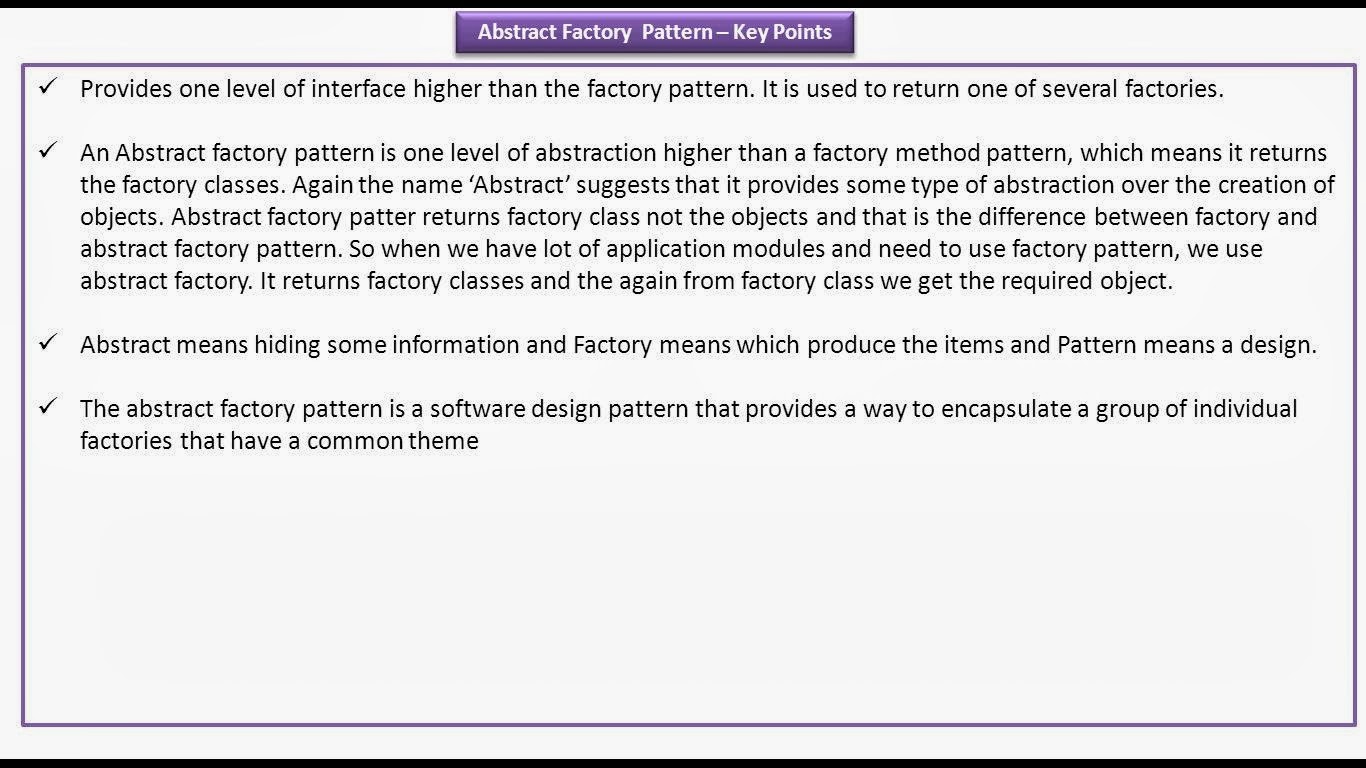
The Abstract Factory Design Pattern is a creational design pattern often referred to as a "Factory of Factories". It provides an interface for creating families of related or dependent objects without specifying their concrete classes.
Instead of creating objects directly using concrete constructors, client code requests objects from an abstract factory interface, ensuring that related objects (such as UI buttons and scrollbars for a specific OS) are always created together consistently.
Essential Key Points to Remember
- Family of Products: Abstract Factory focuses on creating entire families of related products rather than single individual instances.
- Loose Coupling: The client program is completely decoupled from concrete implementation classes. It interacts solely through abstract interfaces.
- Open/Closed Principle: You can introduce new variants of product families into your application without breaking existing client code.
- Single Responsibility Principle: The object creation logic is centralized in dedicated factory classes, simplifying maintenance and testing.
- Consistency Across Products: Guarantees that products created within the same family are compatible with each other.
When Should You Use It?
The Abstract Factory pattern is ideal when:
- A system must be independent of how its products are created, composed, and represented.
- A system needs to be configured with one of multiple families of products (e.g., cross-platform UI themes, multi-cloud storage adapters).
- A family of related product objects is designed to be used together, and you need to enforce this constraint at runtime.
Watch More Related Design Pattern Tutorials
Click here to watch in Youtube : https://www.youtube.com/watch?v=oQflDHmSACg
Click the below Image to Enlarge


See also:

No comments:
Post a Comment